Tag Archives: science

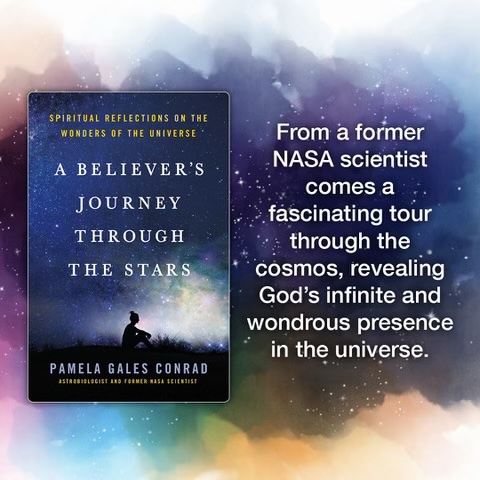
A Believer’s Journey Through the Stars

by The Revd Dr Pan Conrad

Here is how the publisher describes the book:

In this thought-provoking guide, Conrad invites readers to explore the vastness of outer space through both the lens of faith and the rigor of science. From the life cycles of stars to the gravitational pull of the moon, each reflection weaves together scripture, scientific insight, reflection questions, and prayers—offering a fresh perspective on how the heavens truly proclaim God’s glory.

Drawing on her experience working on NASA’s Perseverance Rover, as well as her role as a priest, Conrad bridges the gap between the material and the spiritual, encouraging readers to embrace both curiosity and contemplation. Whether pondering the expanding universe, the delicate balance of Earth’s ecosystems, or the mystery of the Trinity across the dimensions of space, this book illuminates how science and faith point toward the divine together. Perfect for seekers, scientists, and stargazers alike, A Believer’s Journey through the Stars is an invitation to stand in awe of God’s creation—and to find deeper meaning in its beauty.

Southern Chapter September 2026

30 September 2026

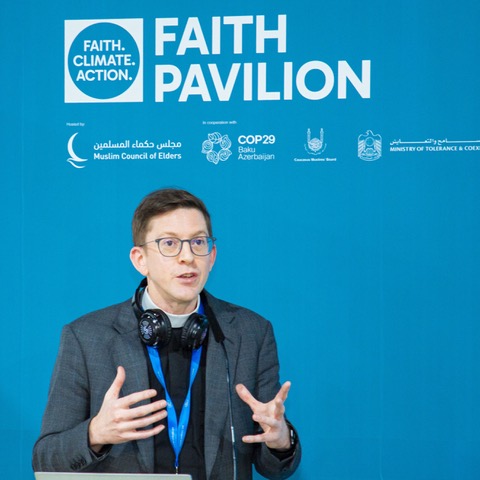
Speaker The Revd Professor James Walters
Climate and Creation: Engaging faith communities in climate science
St Stephen’s Rochester Row

12.00-12.30: Arrival; Tea & biscuits
12.30: Eucharist (open to the public)
13.10: Lunch
14.00: Talk & discussion
15.00: Departure

Climate and Creation: Engaging faith communities in climate science
The parts of the world most impacted by climate change are simultaneously the most religious and those with the lowest levels of scientific education. This is not to say that such groups see religion and science as necessarily in tension. But the dominant framing of the climate emergency in technical scientific language alienates these populations from this issue which is acting them so profoundly and which they describe in their own more moral/theological language. Professor Walters will outline the work of his research unit in listening to these religious voices and drawing them more fully into the global climate conversation.

The Revd Professor James Walter
The Reverend Professor James Walters is the founding director of the Faith Centre at the London School of Economics. The centre works with LSE’s diverse student body and wider global publics fostering interfaith dialogue to address conflict and the challenges of the climate emergency. He was ordained in 2007, served his curacy in Hampstead in North London, and has been at the LSE since 2010. He is an honorary canon theologian at Chichester Cathedral.

Going forth to Experiment


Warden’s Address from Lucas Mix,
Warden of the Society
Society of Ordained Scientists, Gathering
, Hinsley Hall, UK, 2025
Isaiah 42:5-12; Matthew 10:7-16

The world upsets me right now.
I wish the wars would stop.
I wish the US government could be part of the solution,
instead of always seeming to be part of the problem.
I wish the Episcopal Church, and the Church of England,
and the Anglican Communion could get over themselves
and do the work we are called to do.
I want these things to change,
But I know they are not mine to change,
nor are they entirely someone else’s.
That’s the challenge.
I am part of the world at war. I am part of the US. And I am part of the church.
What am I to do?
There’s something truly frustrating, if that word is strong enough,
something angering, disempowering, soul-crushing even,
about being in the middle space.

God grant me courage to change the things I can,
Serenity to change the things I cannot,
And the wisdom to know the difference.

What do we do with the middle space,
Where we cannot summon the energy to act
Nor the emotional distance to accept?
That, for me, is the Climate Crisis in a nutshell.

Then we get the passage in today’s Gospel:
“As you go, proclaim the good news,
‘The kingdom of heaven has come near.’
Cure the sick, raise the dead, cleanse the lepers, cast out demons.
You received without payment; give without payment.”
And I must confess to a bit of petulance.
Give me a break, God. You ask for the impossible.
I cannot cure the sick, raise the dead, cure the lepers, or cast out demons.
Who am I, that God asks these things?
I am tired, I am old, I am weak.
(I think this is true even for those of us in their teens.
It’s the time we live in.)
Give me a show of hands. Does this feel like it applies to you as well?

I am grateful for the opportunity of a three Eucharist retreat.
It gives me the space to inhabit discomfort in a way
that I would never dare in a single sermon.
It lets me name the weakness and acedia that creeps up on us.

I went to a seminar recently with Dr. Caroline McCalman,
a social scientist at the University of Birmingham.
She shared her surprise that, upon interviewing Climate Activists –
people she had identified for their environmental work –
they uniformly denied that they were, quote, environmentalists.
They felt their work was not having a big enough impact,
that they had not sacrificed enough to identify that way.
Or, to use the language of religion,
they feared their sacrifice was not worthy
and, therefore, their sacrifice was not accepted,
and, therefore, they were not sanctified by the act.
They did not know how to make an acceptable offering.

I think this is what trips me up.
When I read Matthew 10, I hear
Go out and do these things – you are responsible for the consequences.
But that is not Good News in this time and place.
Perhaps it was for the original hearers of Genesis and Leviticus.
I do not know.
The Good News for the Psalmist was something different
“the sacrifices of God are a broken spirit; a broken and contrite heart,
O God, you will not despise” (Psalm 51:17)
And for Micah:
“He has told you, O mortal, what is good;
and what does the LORD require of you
but to do justice, and to love kindness,
and to walk humbly with your God?” (Micah 6:8)
I could leave it there, and say something like this:
Go out and try to do good – God is responsible for the consequences.
There is truth to that as well, but it is still not Good News, I think.
It is duty without reward,
Noble and grand, but ultimately fruitless.
So, I turn to Mark 4 and First Corinthians 3
We water and plant, but God gives growth.

And God does give growth.
I was doing some research lately,
and just a very brief search turned up interesting results.
The Center for Theology and the Natural Sciences at Berkeley was founded in 1981.
The Ian Ramsey Centre at Oxford was founded in 1985.
The Faraday Institute at Cambridge was founded in 2006.
I found Science and Religion courses at
Edinburgh, London, Oxford, and Leeds
With modules at Cambridge, Durham, and countless others.
Looking more closely at ecotheology,
I found courses at 24 universities in North America,
alongside Edinburgh and Oxford, here in the UK.
There are also quite recent masters’ courses
at Sarum, Nazarene, and St Augustine’s, training people for ministry.
Not to mention modules in most mainline and liberal seminaries
across the ecumenical spectrum.
For a field of study and an area of ministry barely heard of 50 years ago,
that’s a remarkable change.
Theology is different than it was.
The church changed and the world changed.
Looking around this room –
and thinking about the Society of Ordained Scientists –
we played a major role in that.

I do not have power,
but we do.
And, connected to communities of science and faith, as we are,
we have more power than most.
It is not perhaps, as decisive or autonomous as we would wish,
but it is power.
There is authority and grace in that power,
when we look for it.
There is something of God.

And so, perhaps, we can read todays passage in a different way.
“As you go, proclaim the good news,
‘The kingdom of heaven has come near.’
Cure the sick, raise the dead, cleanse the lepers, cast out demons.
You received without payment; give without payment.”
Perhaps, it looks more like this:
Go out and do these things – and witness what happens.
Perhaps it looks like an experiment.

What have you done that did have power?
With whom did you work?
With what lever did you change the world?
That is the question.
We are here because we, together have power.
It is not perhaps, as decisive or autonomous as we would wish,
but it is power.
There is authority and grace in that power,
when we look for it.
There is something of God.

I can’t tell you exactly where it lies,
how it works,
or what we are called to do with it.
That is the work of the coming year.

This, then, is the Good News,
and this is the invitation.
Let us go forth and experiment,
in prayer and in action.
Let us ask God, what we are called to do,
in expectation of an answer.
Let us act in the world,
in expectation of making a change
and watch closely for the results.
Let us come to the table,
in expectation of being fed,
of being strengthened,
of being healed,
and growing and changing and bearing fruit.
Facts and Comments


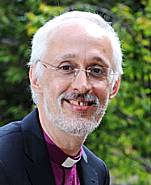
Sermon notes for the Admissions Eucharist from Dr. David Walker,
Bishop of Manchester and Visitor to the Society
Society of Ordained Scientists, Gathering
, Launde Abbey, UK, Summer 2024

“Facts are sacred”, wrote CP Scott, long time editor of what I still like to refer to as the Manchester Guardian. “But”, he added, “comment is free”. Having been subject to the on-line reaction when I’ve written for Scott’s former paper, I can testify that those submitting comments exhibit no lack of freedom, or indeed any other inhibition that one might expect common courtesy or decency to place upon them. Scott made it a hallmark of his editorship not to confuse these two.
One of my own media sidelines is to be part of the team of presenters who bring listeners Radio 4’s Thought for the Day from Monday to Saturday, at around 0745. Because it is an uncontested slot, by which I mean that nobody gets to challenge me on air, or demand right of reply the following day, the rules are very strict. I work alongside a producer drawn from the Religion and Ethics team, who has two principle tasks. The first is to help me get my point across in as clear and concise a way as possible (I have a maximum of 2 minutes and 50 seconds, which amounts to around 450 words). The second is to ensure that, whilst I might range far and wide in the opinions I express, I have a firm evidential base for anything I present as fact. Listen carefully, and you’ll hear us presenters use little phrases like “as I see it”, “in my view”, or “for me”, to bridge the gap between fact and comment.
Science, is an exercise in finding facts, discovering the truths about the world about us. We propose and test hypotheses until we have confirmed them to a high level of probability. We can then treat them as factual unless and until fresh evidence arrives that makes our earlier conclusions unsafe. In that sense science operates a bit like the criminal court system, where an appeal can be heard if new and compelling evidence emerges. Perhaps the main difference, one for which we are profoundly grateful, is that the findings of which we become convinced and convicted are less likely to result in our being sent to prison. At least in most parts of the world. We may have our opinions on scientific matters, but woe betide any scientist who fails to follow Scott’s dictum when publishing in an academic journal.
Most people, most of the time, operate in a world beyond science, very much on the “comment”| side of Scott’s distinction. It’s a world where opinions and beliefs do not have to be quite so securely grounded in hard evidence, nor demonstrated beyond reasonable doubt. We don’t need a logical basis for preferring the work of one artist to another, or liking different types of music. We don’t need incontrovertible evidence to justify thinking one football team to be better than another, nor to form a view as to which political party is best placed to lead our country over the next few years. The problem comes when Scott’s boundaries get blurred, particularly if done so with intent.
Politicians are, I suspect, particularly inclined to overstep the boundaries between fact and comment. And it can’t help that most of them come from non-scientific backgrounds, where such behaviour is more acceptable. Here in the UK, the first main skirmish of the current campaign came when the Conservatives tried to package as factual, estimates of Labour’s tax policies that had been drawn up on the basis of assumptions chosen by Tory advisors. “Garbage in, garbage out” as we said in the earlier days of computers. And yet, even though the Civil Service moved swiftly to rubbish the figures, they are still being trotted out as though they had a sound factual basis. Indeed Labour have largely given up on refuting the allegations, in favour of presenting their own dodgy data instead.
As both scientists and ministers of religion, we in this Society are in a good position to understand both hard evidence driven facts and matters of opinion. The same evidence of the world around us can, and does, lead us to quite different theological conclusions. So how do we maintain clarity as to which side of Scott’s boundary we are standing on?
Well, one of the things I have learned from almost a quarter century of being a bishop, is how important it is for me not only to understand the perspectives of people whose opinions are very different from my own, but to be able to argue their case along the lines that they would argue it themselves. People really appreciate being understood, and their opinions respected, even when they are not agreed with. Yet where I find I have to resist is when I am asked to give equal space and respect to arguments that play fast and loose with the facts. Or where clear and demonstrable facts are denied because they fail to support the opinion someone wishes to maintain.
So, one of the things that grieves me most in an election campaign is when interviewers treat false facts with the same respect that they properly offer to diverse opinions. I still shudder at the comment of a former, and possibly future, US President who, confronted with the falsity of his statements, spoke simply of having “alternative truths”.
“Facts are sacred”, said Scott. Most of the time, in that sentence, the emphasis is placed on the first word. But we, above all others, should understand what that final word “sacred” means. It goes beyond saying “treat with respect”. To be sacred is to be precious to God. We follow the God of truth, the God to whom truth matters. We need to treat facts with the same reverence as we treat other sacred objects or entities; to recognise that they might form the basis for comment and opinion, but can never be collapsed into them. And maybe, our dual training, as scientists and theologians can help us do that, both for our own benefit and the benefit of our congregations and communities.