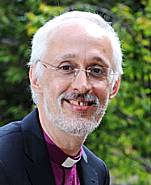
Sermon for the Admissions Eucharist from Dr. David Walker,
Bishop of Manchester and Visitor to the Society
Society of Ordained Scientists, Gathering, UK, 2019
Not surprisingly, since our first session on Tuesday, I’ve been thinking about stories. I’m sorry I missed much of yesterday, and apologise if anything I say repeats (or worse, contradicts) what was said then. But then we’re scientists, so we’re used to having to handle corroborating and conflicting data – numbers that fit nicely onto the graph and numbers that are literally way off line.
But we’re more than scientists, we are theologians too. As such we work with the two basic, but separate, building blocks – numbers and words. Our numbers we fashion into formulae and theories, designs and products. Our words we aggregate into sermons and stories, doctrinal teachings and moral imperatives.
I wonder whether that makes the members of this society particularly useful, to both church and science, on those occasions when words and numbers clash and collide.
Last week I was sent a copy of a report on diocesan safeguarding statistics that was shortly to become a press release from the Church of England. It was well set out in a familiar academic style. Each section began with a very brief introduction, leading into a series of tables and figures, and was then followed by a few lines of text analysing what the numbers might mean. I was invited to comment on it, as the nearest to a statistician among those who have to field media enquiries on behalf of the Church. They numbers made sense, the textual description fitted them, but the overall effect wasn’t quite right. Bluntly, they lacked a story, or the story came too late. By the time a journalist had glanced at a few of the statistics, they would be writing their own narrative around them, with greater regard for what made good copy than for the truth of their assertions. Better, earlier narrative would make it harder (though I’m sure not impossible) for the numbers to be pressed into the service of some hostile agenda.
The suggestions I made were little more than probably any of us here today could have done. The paper just needed someone confident enough with both numbers and words to see how the two could be assembled into a coherent message.
As I mentioned to my small group on Wednesday, I learned how easily numbers lose out to words some years ago. Well over a decade ago, at a parliamentary launch event I was given a series of credit card sized pieces of paper that statistically demolished the ten most popular myths about migration. I thought it was a great piece of research, and bound to change minds. It had no impact whatsoever. A third hand story about someone’s daughter being denied a council house, and then seeing a family assumed to be foreigners moving into such a property the next week, carries far more weight, even if it is wildly inaccurate, than any well evidenced argument that migration has very little impact on housing waiting lists.
Entire chunks of UK welfare benefits policy have been based on the power of the narrative around the tiny numbers who seriously abuse the system, even if eradicating their abuses can only be done at the cost of catching many more innocent people in a poverty trap. I suspect every single family with ten or more children reliant on state benefits, and there are only a few dozen at most in the land, has had its day on the front page of at least one tabloid paper. Stories trump numbers, especially when those stories chime well with what we want to believe to be true. Confirmation bias is alive and doing very well, thank you.
Many of us here are people who are comfortable around numbers. We calculate and calibrate with them. We see them as our friends, and we treat them with the respect that friends deserve. Yet we ourselves fall victim to confirmation bias if we assume that others share that perspective. My wife Sue, who will be ordained as a Self Supporting Priest later this month, did some of her research into maths anxiety. In Western society to be illiterate is shameful, to be functionally innumerate is almost seen as a badge to be worn with pride. Outside the scientific community, and in the church as much as anywhere else, numbers are feared, misunderstood, shunned. Within science, words are often awkward, poorly delivered. We’ve all sat in the lecture theatre whilst the wonders of nature are rendered banal and boring by the limitations of the speaker’s language. The force and delight of discovery is often diminished or deflected by the weakness of how it is expressed.
So, are there ways that we can serve the church and society as those who have had to prove ourselves in both fields? Let me offer just two examples. You can think up your own later.
Challenging narratives that twist the evidence with ones that are equally, if not better, stories, yet are grounded in reality and can, when called upon, be supported by the data. When I was asked, following a lecture given whist I was in the USA for the Society’s retreat there, to turn my PhD into a book, I knew I would have to replace the statistical tables, much though I loved hem, with example. At the publisher’s request I’ve recently turned the same theory into a series of daily devotional readings for Lent, to be published later this year. A lot of my broadcasting work is grounded in the belief that there is no such thing as effective prose, only poetry that is travelling incognito.
Explaining scientific theories and technological advances in well-crafted prose. It can be done. Few people understand the equations that underlie quantum mechanics but far more think Schrödinger had a cat. The popularity of black holes is probably 75% because they were given such an evocative name. How can we, who are required by our ordination to be wordsmiths, help science find its language more reliably?
 Society of Ordained Scientists