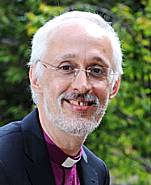
Sermon Extracts from Dr. David Walker,
Bishop of Manchester and Visitor to the Society
Society of Ordained Scientists, Annual Retreat, 2017
Douglas Adams, in his Hitchhikers Guide, tells the story of a huge computer, which in a short time begins with “I think therefore I am” and deduced the existence of income tax and rice pudding. Adams appeals to a particular view of science as driven by logical necessity, one seen again recently when another atheist entertainer argued that 1000 years after an apocalyptic event science would have reinvented all that had been lost whilst previous religions would be totally forgotten. This view of science plays to the old image of the man (or just occasionally woman) in the white lab coat, holding a test tube. In the convention, that individual would have superhuman intelligence combined with the emotional and artistic capacities of an earthworm.
No doubt there are some scientists who are so coldly rational that they are capable of committing any conceivable act in the pursuit of their studies. The Nazi trials of 70 years ago threw light on some grave abuses of human rights that that took place, in the name of science, in camps such as Auschwitz. But that is not the way that science as a whole progresses. Outside the world populated by Adams’s fictional hitchhiker, there is no such thing as a truly rational rice pudding.
The scientific task is not just logical, it is aesthetic, artistic, moral and spiritual. Which is where you and I come in.
I discovered early on in my own research career, that the answers we find depend hugely on the questions we ask. It often takes far longer to find the right question than to answer it. Our choice of questions is determined to a large extent by factors such as what we think will be useful, what appears to have innate beauty, what may lead to morally good applications, and what funders are prepared to pay for. All of these are issues I face just as much in my day job as a bishop, and indeed they are matters we all face as Christian ministers.
So how can we use our grounding in both the fields of faith and science, so as to be a priestly people for the good of humankind? Rather than generalities, let me briefly look at three specific areas, but then the principles can be applied more widely.
Medicine and pharmacology
Statins and the CT scan. Why do I get offered a choice of treatment when many others don’t?
Misuse of antibiotics, the tension between now and the future.
Manchester story, how nineteenth century scientists began to study the diseases and injuries of the working classes.
Climate change and human sexuality
How do we deal with politically or religiously driven minority research?
When is a consensus a consensus?
Particle accelerators and space probes
How much of the science budget should be spent on going beyond the obviously useful?
The true rice pudding is much more than the logical consequence of heating up plant seeds in liquid. It’s a mouthwatering combination of flavours; it’s a means of feeding the hungry; it’s the use of a readily affordable crop that will grow well and cheaply in wet environments; it’s a lifesaver for those with wheat intolerance. And for you and for me, it’s something over which to offer thanks to God.
 Society of Ordained Scientists