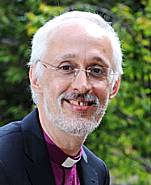
Sermon given by Bp. David Walker, Visitor, at the Annual Gathering 2016
In the time I have spent as Visitor to this society, it seems that I’ve observed three aspects of its role. And preparing for this few days with you it felt like I’d been around long enough to now begin to report back on my observations, and see if you agree. After all, moving from observed phenomena to the construction of a hypothesis lies at the heart of the scientific method.
To begin with, it exists to show that it is possible to be a person both of deep Christian faith and of sound scientific credentials. It meant a great deal to me, as a young student at Cambridge, to attend not only scientific lectures given by John Polkinghorne but also listen him address a Christian fellowship. If he, the Professor of Particle Physics could combine science and religion, then certainly a mere undergraduate in his department could do so. It was noticeable back then that the people who were most inclined to tell me that science and religion could not coexist tended to be not only irreligious but also non-scientists. The scientists, and the religious, knew better.
I suspect that this has, if anything, got harder over the intervening years. Firstly, there are probably fewer scientists today who had their upbringing in a church going family. It is always easier to be hostile or indifferent to something you have not experienced or that doesn’t touch the lives of your immediate relatives and closest friends. Secondly, the increased stridency of forms of Christianity that clearly despise science and will only give credence to theories that lie entirely within their theological framework, has discredited all people of our faith. W e are all assumed to subscribe to the doctrines of the most fundamentalist. And if we don’t, then that is taken as evidence that we are not really as religious as we pretend.
My worry is that we are less likely today, even than a single generation ago, to get near enough to many scientists to be able to demonstrate that we have the integrity that we do. That’s why I’m extremely grateful to David Wilkinson and his colleagues in Durham, for creating space in recent years for senior religious leaders and front line scientists to meet up and simply get to know each other through conference of a couple of days or so. The enemy of both science and religion is ignorance, and ignorance of each other risks making us enemies. I’m also grateful to programmes such as God and the Big Bang, which puts scientists of faith into sixth form classes, where they have a chance of engaging with at least some of those who will be professional scientists in future. W e need to support such programmes. The return on investment may not be immediate but the longer term impact may be vital. I was very lucky as a teenager to attend a school where nobody was allowed to do more than three A levels, and where the remainder of lessons were deliberately drawn from outside of the range being studied for examination. Those of us who were learning sciences were required to choose additional options that bent towards the humanities, and vice verse. I’m not convinced that many schools take that line today. Maybe, where we are school governors, we can at least ask the questions.
My second observation is that we exist to help the world of science. A good and current example would be that of climate change. The contribution of faith has been essential both to set a framework in which research into this topic has been widely supported and through which the findings of scientific research have been propagated and publicised. Modern science is not any longer carried out by parish clergymen with a university education and lots of spare time on their hands. It requires funding and funding requires political support. And that support is often resisted by those who have strong vested interests in the status quo. A good theology of creation and of stewardship has a vital role to play in maintaining the weight of public support that holds politicians to continue to let funding flow for the research, when private sector money is either not available or would corrupt the programme. And climate change is an excellent of example of how people of faith, led by good theology, have been at the forefront not just of practical action but of disseminating the findings of research. Again, too important to be left to the publicity machines of the commercial lobbyists.
But climate change is not the only area in which good theology can support and help good science. W e’re fortunate in having Bishop Lee Rayfield as one of our society members. Lee’s work, in the field of bioethics, is a great example to us. When science runs too far ahead of an ethical base, even more so when it denies the need for ethics at all, it not only risks prostituting itself to the basest customer, it risks losing the public support within which it must always operate. It isn’t
possible to separate the question of what can be done and what should be done within the world of research. And scientists are often not the ones best equipped to evaluate ethical considerations. What you and I know, and what needs to be at the heart of our particular contribution, is that in the absence of an ethical framework for scientific research being informed and influenced by theology that is friendly to the scientific quest, the framework that is set up will be influenced by theologies that are much less sympathetic.
My third aspect of our role ought to be the easiest, but I fear is perhaps the hardest of all. W e are to see that theology and religion does its work in a manner that understands science and incorporates best scientific practice. This isn’t just, indeed it is hardly at all about challenging the wackiest theologies that fly in the face of basic scientific consensus. It’s more about trying to encourage the church to do its own research and to base its decisions more solidly in evidence. One of the most important but grumbled about departments of the Church of England is the small national unit that works on research and statistics. Clergy moan more about filling in annual statistical returns than about almost anything else except their Parish Share. Last month I attended and presented a paper at the biennial conference of the International Society for Empirical Research in Theology. It was about the fifth such conference I’ve attended, and probably the best yet. W e had soundly researched papers on a wide range of topics that could and should be guiding churches in the establishment of their policies and practices. And yet all too often when research findings come up against previously held positions or personal preferences, it’s the research that loses out.
Many of you will know, we submitted a contribution to the Pilling group on human sexuality a few years ago. It set out where the overwhelming weight of scientific opinion lay, as well as where opinion remained divided. Nobody was suggesting that the ethical issues around same sex relationships could be entirely determined by the observation of similar behaviours in other mammals and primates, or by the majority view on nature versus nurture. But it was depressing to see that the report simply noting that as there were some scientists who took views contrary to the consensus, everything was still open for debate and the evidence could be largely discarded.
As a society we are better placed than most to be able to tell the difference between genuine areas of scientific disagreement, where much is still to be decided, and where the division is between a broad consensus and a resistant rump, the latter often having external reasons for the positions it holds.
Some harder today, for each member of the society, as we affirm our promises and commitment, as that each of us may find one of those three aspects of our life to which we can make a particular effort over these next twelve months. So that between us we can continue to further the cause of good science and good religion being good friends,
 Society of Ordained Scientists