Tag Archives: christianity

World Views on the Macro and Micro Scale

A sermon by the Rev. Dr. Keith Suckling, Warden at the Society’s Gathering at Scargill, July 2015

I was glad to hear in David Gosling’s talks at this Gathering his experience of aspects of Buddhism, Hinduism and Islam which he shared from his periods of time in South Asia. It should not have been a surprise, but it was still very striking to see the differences in the world view of these cultures almost at first hand. We are of course familiar with the concept of world views and the conflicts that can arise when they come in close contact. The readings we have heard this morning give us a scriptural context. The story of the Tower of Babel (Genesis 11.1-9) can be seen as the point at which world views began to diverge. More significantly, Jesus points out to his disciples that the world view which he represents is fundamentally different from that held by the wider society in which we live (John 14.22-15.1).

It is a familiar picture, but sometimes small events bring the real situation into closer focus. Early in 2014 I received a completely unexpected invitation from the Bishop of Aberdeen and Orkney to come to Fraserburgh in north-east Aberdeenshire as Priest in Charge of St Peter’s Church. It was the kind of email which demanded taking very seriously and after a period of discernment and the necessary visits Helen and I moved to Fraserburgh in October. There was a very strong sense of being led by the Holy Spirit, of which more towards the end.

Shortly after arriving I made contact with some local schools and some weeks later this was followed up by a request for a discussion with a sixth year student who was working on a project on assisted dying. Legislation was in progress in the Scottish Parliament at the time (although it subsequently failed). I had a good discussion with the student and she was grateful to hear a point of view which was new to her. She had carefully gathered views from her own circle, family and friends, and it seemed that most of the opinions she had heard came from a utilitarian and pragmatic perspective. We are familiar of the idea of a conflict model between religious world views and secular ones, but on the basis of this and related experiences, I think we need to replace it with the ignorance model. It may not be too extreme to suggest that in the Venn diagram of these world views there is practically no overlap.

And still the regular traffic of confused debate continues. The challenges of natural disasters and suffering remain, God is accused and answers are demanded, but we can only have a debate when there is some common ground to work on. Fundamentalist atheism is no longer respectable intellectually but still dominates media discourse. All these factors and developments suggest that the ground in which we operate has slowly been shifting and now is quite different from what it was 30 years ago when the ideas of forming SOSc were taking shape. If people don’t know what Christianity is they are not going to be particularly bothered about the subtleties of the science/religion debate. But the fact that some people pop up here and there who obstinately try to live fully within the

world view of a religion but who also accept and indeed celebrate the kind of data that the secular world needs to rely on sometimes stops the secularist short. Yes, amongst others, we are those people.

Christianity has to recover by people wanting to be part of it. You join a club, a sport or a society because it seems attractive to you. You don’t know everything about it at the time but you are prepared to give it a try. But it’s got to be attractive enough – to raise interest and curiosity. To those who follow a different world view, we are, using the word in a different way, curious people, but maybe we are ones who raise enough interest so that it gets to be followed up at some time in the future.

This continues to be our role in SOSc, and it is exactly as the aims of the Society were conceived 30 years ago. Perhaps some of the wider church is beginning to pay more attention. We continue to be, as I said two years ago, the data and the evidence. Or, put a little differently, we are and we inhabit and we have to remain the common ground, the more visible the better. In fact, we are getting some response to our publicity. In the past six months there have been more email requests for information about the Society with a view to membership than ever before. There is the unmeasurable but real trickle effect of people who have come into contact with our members telling others about us. Those of us who use social media can have an encouragingly wider impact.

Having made a major and unexpected move in the past year, and starting off with an agenda in mind containing far more things that could be done than are possible, I’m quite clear that we as a Society also have to continue to expect to be led. It’s that peculiar partly proactive and partly reactive state where we try, with the guidance of the Holy Spirit, to synthesise all sorts of inputs, some specific and defined, some vague and hardly sensed. It’s one that sees opportunities as they appear and, after appropriate discernment, takes them and manages to make progress without needing to have all the milestones defined in the way that we did for the kind of drug discovery programme I used to lead. Fuzzy. Often challenging to the scientific mind.

We can only be effective in taking the opportunities that offer themselves to us if our primary response is to God and to God in creation. This is what we share today as we celebrate the Eucharist with a eucharistic prayer from Operation Noah. I’ve talked mostly about the outward role of the Society, about our world view and others. But now as we worship together, this is the internal strength of our community. The real sense of community is never stronger than at this point in the Gathering. All that we stand for is enhanced and deepened and as always, I feel warmed and greatly encouraged by our time together.
Believing in Evidence

Sermon by Bp. David Walker (visitor) at the North American SOSc retreat, 2014

Nine months ago I was summoned to be interviewed for the post of Bishop of Manchester. It was quite an exercise. First I had to preach for five minutes on the readings of the day. Next I was required to produce a ten minute presentation on a subject chosen by the panel; which happened to be the theology of William Temple and its relevance for Manchester today. Finally, I was submitted to an hour of questions from sixteen people arranged in a large horseshoe. A few days later, by which stage I had been told informally that I was the preferred candidate, I bumped into one of the bishops who had been part of the panel. “You’re different from the rest of us, David” he said. “You really believe in evidence”. It’s possibly one of the nicest things anyone has ever said to me. And I think he did intend it as a compliment.

I also think that it’s a particularly appropriate compliment to pay to the Visitor of this society, because as ordained scientists, the members of SoSc are called to be people who weigh evidence and, along with that evidence and powerfully influenced by it, believe. So let me simply, for all of us here today and especially for those to be admitted to the society, offer some thoughts on what it may mean to be those who “believe in evidence”.

Painting with a full palette

The definition of an expert, as I imagine you are all aware, is that it is somebody who knows almost everything about almost nothing. Specialisation, particularly in science, leads to ever finer divisions into fields that can become so arcane as to be impossible even to state to an outsider. At the turn of the twentieth century, the great David Hilbert listed the top ten unsolved mathematical problems of the day. By and large they were all at least explicable in language an educated non specialist could understand: Fermat’s last theorem and the four colour problem being perhaps the best known. My recollection is that just one remains unsolved. Yet when another nine were added to it to create a top ten for the new millennium, most of them require a considerable amount of prior mathematical specialisation to even begin to understand what the problem means. The days of the generalist scientist, of whom so many were ordained, are long past.

Yet within this ever increasing specialisation are two countervailing forces. Firstly, we can note a dawning awareness that often the solutions to problems couched in the language of one particular field lie at least partially in another area of study entirely. The paradox is that to be fully effective within it, researchers need to engage outside their immediate zone of expertise. Secondly, once we pull back from the frontiers of knowledge and seek to live coherently within the world, we are immediately compelled to construct our attitudes and activities from theory and evidence drawn from many different disciplines.

For you and me there is a very sound reason for applauding this. When we read the gospels we see immediately how, for example, Jesus brings together deep knowledge of the Jewish scriptures, profound observation of nature, acute understanding of human psychology, all in order to address a specific subject. To the people who heard him it would appear to be this ability to synthesise that rooted his teaching in a holistic reality and gave it an authority that contrasted with that of his contemporaries.

The call to us then is to be like the good rabbi of whom Jesus speaks, who can bring out and put together the old and the new. It is to be those who are prepared to paint with the whole available palette of human wisdom. In particular, as a society we have the locus to offer our shared theological training and our very diverse scientific disciplines in order to address the issues of the day. And I do believe this takes us beyond the initial vision of our founders. We are more than a third force in a fruitless culture war between fundamentalist belief and reductionist science. We are a society of those who can individually and corporately make a powerful contribution in the public square. And whilst it is always a little invidious to single any of our members out, for the sake of examples (always important to a scientist) I would draw attention to the writing on environmental issues of David Atkinson, of Lee Rayfield on issues in medical

ethics, and the collection of essays on human sexuality submitted as evidence to the Church of England’s recently published report on the topic. In each case it is the ability to speak from a solid theological and scientific grounding, a belief in the evidence drawn from both, that makes the impact.

The measure of doubt

I was privileged as a young undergraduate to be on friendly terms with a then elderly philosopher, among whose claims to fame was that in his rooms at college a fierce debate had once taken place on the subject of belief and evidence. He described vividly the moment, late in the evening, when Popper refused to accept the existence of the fire poker and Wittgenstein threatened to strike him with it.

I am always amazed at the mental gymnastics employed by some atheist friends in the scientific world who spend their lives not believing they have any free will and yet act constantly as though they did. Those with a sense of humour smile and say they have no choice in the matter. I am equally amazed at those religious fundamentalists for whom it seems to be precisely that their beliefs clash with the entirety of the evidence available and require equally implausible mental gymnastics such as imagining God creating the fossil record to fool us, which attracts them to their faith.

You and I are called to have evidence and to believe. Just as there are different standards of proof for a criminal trial and a civil lawsuit, so we are required to weigh the evidence and determine what an appropriate threshold for belief might be in any particular instance. As in the legal example, an important factor is what the practical consequences of belief or disbelief might be. We need to be far more sure before sentencing someone to years in prison than we need to be before deciding which of two protagonists to believe in a dispute over a commercial contract.

You and I, trained in the scientific method, do not believe lightly. The fact that we believe, and believe enough to base our lives on acting in accordance with our beliefs, stands witness to the plausibility of our faith under challenge. Especially it witnesses to the enduring plausibility of faith under scientific challenge. Faith asserts that we must all live by unproven hypotheses, but hypotheses that remain reasonable in the light of all we know.

Worshiping through the wonderful

For my final point I want to go back to the impact on us of being those who grapple with scientific evidence.

The story is told of two astronomers at a Cambridge college who, every time they felt they were thinking too highly of themselves, would go out into the main court at night, look up at the stars, recite a litany of how small humans are in comparison with the visible universe, and then return duly humbled to their port and Stilton.

Whatever our individual disciplines, whether we study the very large or the very small, the very concrete or the very abstract, we are those who have been privileged to glimpse something more than most people can of the sheer size and complexity of the universe. Like those college dons we are drawn to a profound humility. What then distinguishes us from them though is that as “believers in evidence” we are also drawn into a profound wonder that expresses itself in worship. Like Job, at the end of the book which bears his name, we see the glory of creation, and fall on our knees.

Yet what distinguishes the members of this society even further is that we are also those set apart to be leaders of worship among communities who are not scientifically trained or scientific practitioners. In our society liturgies we express a more profound engagement with the creation than is common in standard church services. That is right and proper. But I hope we can also take something of the spirit of worshipping through the wonderful back into our home churches. I’ve witnessed too many Christian communities for whom worship is about escape from the realities of daily life. For those who experience

daily living as oppressive and rejecting, that is to some extent understandable. But how much better it would be to enable them to worship in a way that by its very connectedness with creation calls up a more profound awareness of a God who is so greater than their oppressors that in his strength they can refuse to accept their oppression. Maybe that is a work for this society, and especially for those being admitted

BICEP

Sermon by The Rev. Dr. Barbara Smith-Moran, SOSc, Annual Retreat, 26 June 2014, Whitby

Almost 100 years ago, Einstein predicted the existence of gravitational waves in his Theory of General Relativity. His equations showed how gravity waves are generated by highly energetic events such as the explosion of supernovae or the collision of neutron stars. Einstein also thought that gravitational waves of cosmic origin would be so weak by the time they reached Earth that they would be undetectable. Now thereʼs a challenge, and from Einstein, no less! But, in 40-odd years of searching, direct observation of gravity waves has proven elusive. But the theory is robust, so physicists persist in the search, the way they do, and keep themselves hopeful with successive generations of ever more sensitive detectors.

Meanwhile, though, a team of astronomers have been searching for indirect observation of cosmic gravitational waves. Theyʼve been looking for the effects of the gravitational waves that accompanied the inflationary period of exponential expansion of the universe in the blink after the Big Bang. And last week, the much-heralded paper was published announcing the discovery of what theyʼve been looking for. The interpretation is controversial and awaits confirmation, as always.

So how did the astronomers do that? Well, they built a special microwave telescope at the South Poleʼs Amundsen-Scott Research Station. They built it there because the very cold air is very dry, minimizing microwave emission from water vapor. That first telescope was called BICEP, an acronym for Background Imaging of Cosmic Extragalactic Polarization. Its detectors were sensitive to the polarization of the Cosmic Microwave Background, which is the 3-degree remnant of the light from the Big Bang.

Quantum theory says that by the time that Big Bangʼs light became observable (after 380,000 yrs), it had been imprinted by the gravitational waves of the faster-than-light cosmic inflation and polarized in a particular way. BICEP was designed specifically to pick up the so-called B-mode polarization, a signature of inflation in the super-early universe (10-32 sec). I canʼt possibly explain what the B-mode is, and I refer you to Garth Barber or Cyril Challice or another physicist.

So BICEP stared into space for 3 winter seasons, beginning in 2006, and it found—well, not much of anything, nothing to make headlines. But the theory is robust—or at least tantalizing—so the physicists persisted in the search, the way they do, keeping themselves hopeful with ever more sensitive detectors.

They built a second generation BICEP. So by 2010, they had BICEP2, a bulked-up version of BICEP1, with a bigger aperture and 10 times the sensors at 150 GHz.

After three seasons of observations, the results from BICEP2 really were something to write home about. The research team, led by Harvardʼs John Kovac, made big headlines last March when they announced their results. Their paper came out last week. The polarization effect is only 1 part in 108, incredibly, incredibly subtle.

I want to know why BICEP1 didnʼt see the signal that BICEP2 saw. The answer is that it did see it, but it just didnʼt recognize it in all the background noise it picked up. BICEP1 needed some “tutelage” from BICEP2 in order to know what it was seeing. The astronomers took the BICEP1 spectral data and mathematically correlated it with the BICEP2 data to produce a third, called the cross-correlation, and there it was—out of the noise jumped something similar to the signal seen by BICEP2. Cross-correlation did the trick. Itʼs a really powerful technique.

…………

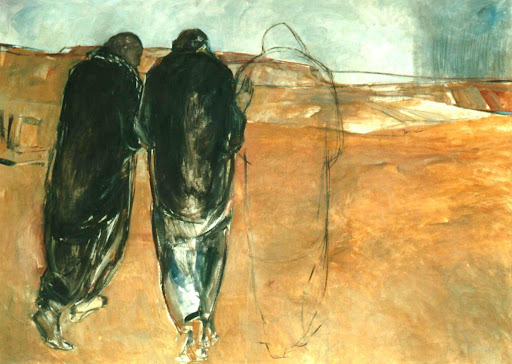
So, that very day two of them were going to a village named Emmaus, about seven miles from Jerusalem. We know that our Gospels contain two kinds of parables: parables told by Jesus, and parables told about Jesus. Todayʼs story of the Road to Emmaus is one of the latter; itʼs a parable about Jesus. It works on two levels, as parables do. And to press cross- correlation into service as a scientific metaphor, let me retell the Road to Emmaus story this way.

Cleopas and his friend were walking together, traveling away from Jerusalem on the Sunday after the Passover. Both of them had been in the company of other Jewish followers of Rabbi Jesus of Nazareth. They had heard and seen something of the things that were being reported about Jesus: especially that he was dead on Friday and alive again on Sunday. Both of them had experienced something of the energy that began to polarize the Jews into resurrection believers and resurrection deniers, into Jesus-is-Lord believers and Jesus-is-Lord deniers.

So on their way out of the center of Passover activity, on their way home, perhaps, to Emmaus, these two are talking. Letʼs suppose that Cleopas was rather animated. Perhaps he had been calling himself a disciple of Jesus ever since he had heard him preaching his own compassionate take on the Law and the Prophets. Cleopas heard Jesusʼs words as a refreshing rain, and he yearned to hear more. But then those insistent kill-joys, the Roman authorities, had killed Jesus right at holiday time. That was only last Friday; and today, Sunday, the most incredible news had been spreading through Jerusalem: the news that many had seen Jesus alive again, and walking among them, talking and eating with them. Cleopas is confident that the reports are true. He understands the excitement of many of the disciples, and he thinks, cautiously and privately, that he may have seen his own evidence of the Risen Jesus. He felt uncomfortable in the company of those others who had thrown caution to the winds, so he and his friend leave the excitement and confusion of Jerusalem behind and head out.

Walking toward Emmaus now, Cleopas, the more extroverted, does most of the talking. Both of them have been through the same Jerusalem Passover and post-Passover experiences. His friend—letʼs call her BICEP—isnʼt so sure. BICEP is skeptical about the eye-witness reports she heard. She is not easily carried away. She maintains that God has never answered any of her prayers, though she keeps praying. Influenced by Cleopas, BICEP wants to believe, she wants and needs Jesus to be Lord, but she doesnʼt see it, not yet.

As they go over and over their shared Jerusalem experience, Cleopas interprets it in such a way that he, at least, is convinced he can see the hand of God at work. Reviewing the words of the prophets about the coming Messiah, it dawns on both of them, as never before, the relevance of these words to Jesus. The signal just pops out of the noise—and there is

Jesus himself, walking beside them. Both of them see him, walking and talking with them.

BICEP is positively aghast at what she now sees in front of her eyes. How did she miss that before? Apparently, it was there all along, but she couldnʼt see it on her own. It was buried in the noise of coincidence. She needed to be tutored in order to see it. She needed the fellowship of Cleopas. She needed that cross-correlation so the Risen-Lord truth could pop out of the noise of random circumstance in her life. I believe thatʼs how the Counselor, the Holy Spirit often works to guide us into all truth, and tutor us all things, as Jesus says in Johnʼs Gospel, and remind us of all that Jesus has taught us.

When they get to Emmaus, they invite Jesus in and break bread with him to celebrate their experience of his living presence. Then, exhilarated by their discovery, Cleopas and BICEP have no choice, no choice at all, but to turn around and head right back to Jerusalem to hold their own press conference about their experience of the Risen Lord. As the Epistle lesson says, “That which we have seen and heard we proclaim also to you, so that you may have fellowship with us, . . . with the Father and with his

Son Jesus Christ.”
In the name of God, Creator, Redeemer, and Cross-correlator. Amen.