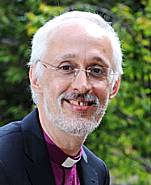
Sermon for the Admissions Eucharist from Dr. David Walker,
Bishop of Manchester and Visitor to the Society
Society of Ordained Scientists, Gathering, UK, Summer 2020
Jesus offers one of his most characteristic challenges in today’s gospel; he warns his hearers of hypocrisy. It’s a term as likely to be thrown at religious people, especially religious leaders, today as ever it was in Israel 2000 years ago. What’s more recent, is that it is now levelled at scientists as well. And responses to the coronavirus pandemic have highlighted the challenge that all those who work in sectors that give advice (directly or indirectly, moral or health wise) to the public, face.
UK based members of this society will probably be familiar with the fact that scientific advisors to both the Scottish and English governments felt compelled to resign for breaking the very clear guidelines on lockdown they themselves had played a part in drawing up and promoting. One had made visits to a second residence away from her city base, the other had allowed his (married) girlfriend to come and visit him in his home. It isn’t only scientists who have been exposed for flouting the rules, others have too, including some very close to the centre of power, and not all have felt the moral imperative to resign, but enough has been said about that. Society, and the scientific community itself, expect a high standard of integrity from those who are engaged in a form of work that has the search for truth at its very heart. Politicians, and political advisors, may have very different needles, if any, in their moral compass.
As ordained scientists, members of this society bring to questions such as these, both our understanding of the scientific process and our comprehension of wider ethical and moral behaviour. Rather than compartmentalise those twin aspects of our vocations, we hold them close together. Our science informs our understanding of ethics, our theology informs our understating of science. And the interplay between science and ethics reaches much deeper into our practices and our lives than simply the well-worn task of getting approval from the academic Ethics Committee for some particular piece of research.
We will ask ourselves whether it is possible to keep entirely separate professional and personal ethics. Is there no correlation between the two? Or does there come a point when a scientist who has justified themselves in hiding a clandestine relationship will be more likely to justify themselves in suppressing experimental data that does not support their hypothesis? It would seem to me at least a plausible hypothesis that, once the principle that it is right to dissemble in order to protect or promote one’s personal reputation has been conceded, it is a far shorter leap to taking similar steps in order to sustain or enhance ones professional reputation. And, indeed, vice versa. Perhaps one of the ways in which members of this society can serve the scientific community is by being a priestly presence, maintaining the centrality of ethical standards, but doing so with both a pastoral sensitivity and a forgiving demeanour.
Having double standards, is of course only one dimension to hypocrisy. And although he denounces it elsewhere, it’s not actually the reason behind the challenge Jesus issues on this particular occasion. In this passage hypocrisy is more about motive than behaviour.
I love the writings of T. S. Eliot, that most English of twentieth century Americans. In Eliot’s play, Murder in the Cathedral, Archbishop Thomas Beckett is visited by a series of tempters in the time before his murder. Having seen off the first three, Beckett believes his challenges are over, he can now go to his martyrdom with a quiet conscience. And then along comes tempter number four. This one doesn’t seek to dissuade him from going to his death, but rather encourages him with tales of how he will go down in history, his reputation will last far beyond his lifetime, for having stood up to the king and being killed for doing so. Shrines and miracles may follow. Beckett almost yields. But then he sees what is happening. “This”, he cries, “is the greatest treason; to do the right thing, for the wrong reason”. Jesus does not level criticism at his hearers for saying prayers, or for being generous to charity. The hypocrisy lies in their murky motivations. A prayer uttered for the sake of pleasing human hearers, has not in truth been addressed to God. A charitable gift made in order to win praise, has not been offered for the benefit of the recipient but for that of the donor.
One of the complexities scientists face today, is that much research is funded not by impartial philanthropists or academically interested governments, but by commercially motivated organisations or by Trust Funds set up to advance a particular viewpoint. What gets researched, and in what depth is not a purely academic matter. And scientists whose findings are unfavourable to some powerful lobby group or commercial interests may find it harder to access grants and funding. It isn’t hypocrisy to explore new and potentially costly treatments for medical conditions, and to seek to recoup the costs of research from the premium charged for the eventual product. But maybe the line has been crossed when equally promising avenues of treatment for the same condition fail to be explored because they would not generate profit. Or when diseases that almost exclusively affect the poor are neglected because the victims would not be able to pay enough for the research to have been financially worthwhile. Motive matters, and we as ordained scientists might see it as part of our vocation to challenge the hypocrisy of Beckett’s final tempter, when he enters the world of science, no matter how alluring his whisperings.
Over these last few weeks, the pandemic has been joined at the top of my work list by the need to respond, urgently and effectively, to the issues raised by the killing of George Floyd. Many words have been spoken in response to his death, not least by white leaders of organisations including churches. Prayers have been uttered, and photographs taken of prominent figures kneeling in support. I have done those things myself and intend to go on doing them.
Yet we know from previous scandals over the ill treatment of black and other ethnic groups that everything, from the micro-racisms faced by our sisters and brothers every day of their lives, to disproportionate killings by police officers, that once the fuss has died down, we tend to go back to how things were before. Our feelings may have been engaged, our morals outraged by the extreme behaviour of others. For a time it has been less comfortable to ignore the problem than to respond to it. But after a while the needle on the comfort scale, for people like me, all too easily shifts back in favour of the status quo. When we speak out and act out, however genuinely in the moment, but within ourselves knowing that we really want the issue to go away and leave us alone. That too is hypocrisy. Our words and our gestures are devoid of true meaning, they mislead and at worst raise false hopes that will all too soon be dashed again when we revert to business as usual.
Double standards, deceptive motivations, and the mouthing of platitudes, are all, if distinct, forms of hypocrisy. Yet between these thorns grows a rose. And it belongs to none of them.
That we have standards which we fail to live up to, is the common lot of humanity – at least among those who accept the existence of standards at all. St Paul writes, with a degree of convolution that resonates with the problem he is facing, that again and again what his mind tells him he should be doing is not what his body compels him to do. This is no simple dualism, though Paul can get close to that error from time to time. Rather, it is a recognition of the pervasiveness of sin.
Those scientists forced to resign from their roles in the pandemic because they had broken the rules were only being hypocritical if they genuinely believed they were entitled to exceptional treatment. If they were trying to keep the rules but had succumbed to temptation, then they are simply weak human beings like you and like me, deserving of our forgiveness. Such forgiveness does not negate the need for them to face the consequences of their misdeeds, perhaps including resignation, so as not to undermine the advice they had previously given, but it changes the moral landscape significantly.
Many aspects of the societies in which we live that have long been present, are being brought to greater prominence and urgency by the coronavirus crisis.
 Society of Ordained Scientists