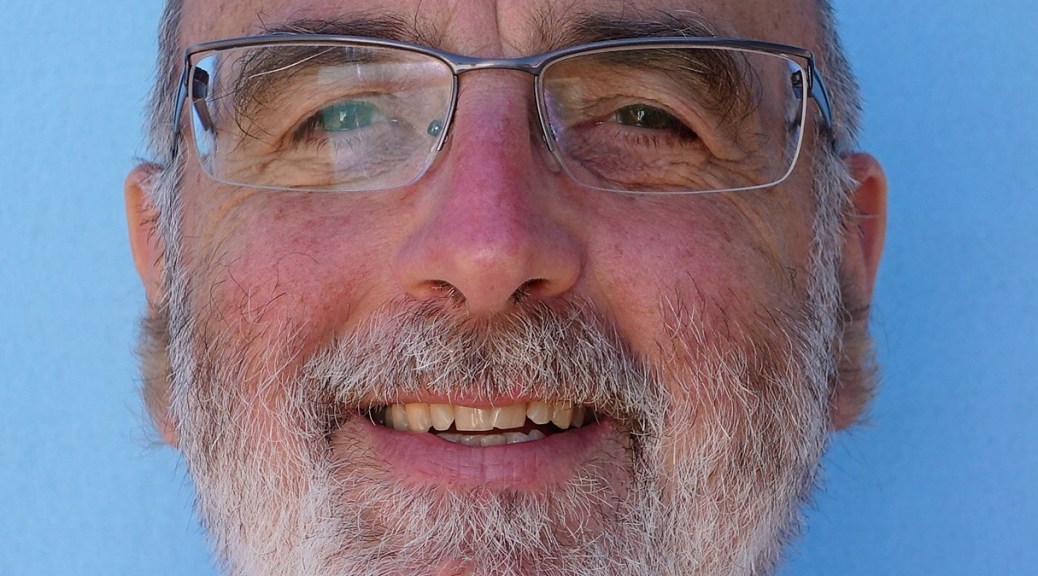
Warden’s Address from Stig Graham,
Warden of the Society
Society of Ordained Scientists, Gathering, UK, 2022
I came across a new phrase last year – or at least a new understanding of an older one ‘closing the loop’. An astronomer was talking about, and I quote, the ‘magical moment’ as a blurred and indecipherable on-screen image resolves into an exquisitely defined picture of a planet, a star or a far away galaxy.
Is it really so amazing though? After all, the CSI franchise, amongst many Hollywood others, has been processing a photograph of a speeding car on a foggy night half a mile away to reveal in pristine condition the number plate of the car and thereby the identity of the culprit for several decades now.
Well, yes, it really is amazing. But much more than that, the real joy, the sense of the magical is coupled with a deep understanding of how it happened: the powerful, fast computers involved, the array of algorithms aligning and controlling a bundle of hardware and software to a minute degree, and ultimately producing, not just data and knowledge, but sometimes something beautiful and unexpected.
Closing the loop is that moment when all comes together, the work, the study, the careful preparation, and from fuzziness emerges clarity, of vision and of understanding.
Closing the loop also reminds me of another scientific descriptive phrase which has illuminated my life and practice: ‘Collapsing the wave front’. I did actually look this up to see how it is presently defined. ‘
In quantum mechanics, wave function collapse occurs when a wave function—initially in a superposition of several eigenstates—reduces to a single eigenstate due to interaction with the external world. This interaction is called an “observation”’.
What a wonderfully laconic afterthought. This interaction is called an
“observation”’. The infinite possibilities of quantum mechanics meet the reality of the one-eyed observer. Shades of Van Moltke’s observation that ‘No plan survives contact with the enemy’. All the planning, the myriad possibilities formulated, considered and adjusted for, but in the moment of contact, a decision, perhaps a decision without alternatives, must be made.
For me, both phrases share a sense of approaching a moment, a cusp point, when we can hold, and contemplate, our discovery. And yet, the other hand, one brings all things together into something greater that its parts, whereas the other reduces all those possibilities together into one outcome. And reducing is not always a bad thing, that is how we make delicious stocks for thing, and, as scientists we do reassure one another, occasionally comfort one another, that a negative result is also positive outcome.
Balaam, Paul and the blind man at Bethsaida, all encountered new and
different ways of seeing the world, quite literally for one of them. Balaam’s encounter with the angel made it clear that the world was not as he thought it was, not least a talking donkey, and that he should return the way he had come. For Paul, for him too, when he encountered the risen Christ, he understood the world was not the way he thought it was, but the only way was forward and yet, at the same time, on a very different path. For the blind man, it seems rather more ambiguous: his awakening is gradual, coming only slowly into focus, with additional
help from Jesus. And then Jesus tells him to go home and not to go into the village. Oh, so wasn’t his home in the village? I remember as a child worrying over the apparent illogicality of that. The sensible adult within me saying, don’t be silly, be reasonable, but the child still says, ‘Yes, but if he did live in the village . . .’
But now, after this week, I have a new problem to agonize over. Which was the clearest perception – seeing people as trees or people as people. The most obvious answer is people but is there a possibility that seeing trees was an indication of seeing through eyes of knowledge and wisdom, a divine perception perhaps. As we have learned, tree mythology interweaves throughout our Biblical texts. Do we grasp
for understanding as we do for a branch? Did he gain insight only to lose it? Interestingly, the story of the blind man is framed by the disciples not grasping the significance of the feeding of the multitudes with each event producing way more scraps than what they started with and followed by Peter recognising Jesus as the Messiah only for them all to be told, ‘Yes but don’t tell anyone’.
My point being – I do have one – is that such moments do not happen in
isolation. There is always an approach, and an arrival and there are always outcomes, consequences, new plans, new ideas. Whether the recognition involves joy, trepidation, or anxiety, whether we see from our present peak to the new and next summit or realise that the peak upon which we thought we stood has crumbled away.
It may be that our momentous discovery is made on Friday evening, and we have to wait in excitement and isolation for the weekend to end and the new week to arrive, to share our news. But Monday morning, decision time, invariably arrives. Whether we close the loop or collapse the wave front we must move on, forward or backward, or on a new path altogether. Neither science nor faith, personal or corporate, can be static. Nature may or may not abhor a vacuum, but it certainly abhors stasis.
We have gained in knowledge this week. Hopefully, we have gained in wisdom too. As we struggle to make sense (well I struggle and am probably not entirely alone) of such a potent mix of symbols, myths, metaphors, and parables and try to decide where to go next, there is comfort in Jesus’ final instructions to Peter and, consequently, to us. Simple words and yet miraculous too. There are, indeed, lambs
and sheep waiting to be fed and tended, to be cherished and nurtured.
 Society of Ordained Scientists