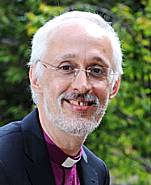
Sermon for the Admissions Eucharist from Dr. David Walker,
Bishop of Manchester and Visitor to the Society
Society of Ordained Scientists, Retreat, Tucson, USA, 10 June 2020
Driving through Tucson a few days ago, we switched on the car radio to listen to the late afternoon news on National Public Radio. The presenter announced the title of the programme as “All things Considered”. I joked to Tom that, given the diversity of opinion in the USA, there was probably a rival station whose drive time broadcast went by the name “Just go with your gut”, or possibly “Hold to your prejudice”.
I didn’t listen long enough to be able to judge whether the show lived up to its name, some of you probably know it far better and can tell me afterwards, but the aspiration seemed an honourable one – that everything should be taken into account, weighed carefully in the balance. Only then should a judgement be made. Moreover, if new evidence or additional perspectives come to light, fresh things not previously considered, then any and all previous judgements must be at least open to reassessment and revision.
One repeated research finding, including from some of my own studies, is that the deeper we go into our faith, the higher we score on the scale known as Quest Religiosity. Quest measures our willingness, and indeed desire, to live with uncertainty. It measures how much we enjoy the fact that our faith is not final and static but developing, as we continue to explore questions for which we have no simple answers. It’s another way of putting what Lucas has been referring to as curiosity in our talks here. As Questing, curious Christians, our conclusions remain subject to revision, as we seek to live a life of “all things considered”.
I suspect that members of the Society of Ordained Scientists all score high in terms of Quest. In your various scientific endeavours, as academics, industrialists, research workers and space explorers, you will have had to develop the desire to venture into the unknown, and to enjoy the process of discovery as much as the things eventually discovered. Part of the charism of the Society is, I believe, to be a cohort of men and women who not only do that with their science, but carry it over to what it means to be an ordained minister in one or another Christian denomination.
The mantra of “All things considered” also flies in the face of that pretence to balanced journalism which consists of getting a protagonist from each of the extreme poles of a debate, giving them equal airtime, and imagining that would cover all views in between. Indeed, the Society of Ordained Scientists began because the public interaction between science and religion was being dominated by the shrillest voices of militant atheism and fundamentalist Christianity.
That same call to holistic consideration also challenges the pattern of presenting, as though of equal worth, both the widespread mainstream informed consensus on some matter and a maverick position. To take a timely example, in my view the overwhelming evidence for the human impact on climate change, and the need to address it urgently, has gone far beyond the point where the views of climate deniers should be entitled to more than a cursory mention in a footnote of the debate. They matter politically because of the extent to which they continue to provide cover for those who choose to resist environmental policies on other grounds – as for example the Prime Minister of Australia, who sees his nation’s coal reserves as a vital economic asset, one which outweighs both the damage done by the fires that have ravaged his country in recent weeks, and the risk of future conflagrations.
Science fails most gravely in its responsibility when it fails to properly consider all things, to weigh the whole of the evidence and to offer that evidence for corroboration and contradiction from other experts in the field. For decades the tobacco companies, and their own research teams, suppressed the evidence that linked smoking to cancer. And this isn’t just an issue of the past. Hardly a year goes by without it coming to light that some major pharmaceutical company has
suppressed evidence in its possession that suggests some highly lucrative product might not, after all, be as safe as its widespread prescription and usage would necessitate. It does concern me that one of the greatest shifts in recent decades is that less and less scientific research is being carried out by wholly independent academics who are free to choose the areas they wish to study and to present and publish whatever findings they may evidence. The dependence of science, even at university level, on sponsorship and support from those with commercial interests in the field, puts the task of considering all things at great risk. Even if a particular project itself has no commercial funding, many academics would be wary, and their employing institutions perhaps even more wary, of doing work that might upset the vested interests who will be looked to in order to fund future programmes of work, or to endow laboratories and research centres. It’s a brave university in the UK that would open up any field of research that might cause concern to the government of China, since so many Chinese students are paying juicy fees into the academic coffers.
I would hope that part of the charism of this Society can be to provide ethical and pastoral support for all those engaged in science who feel they are being pressed to act in ways that undermine the integrity of the scientific process. Those who are being coerced to consider only part of the evidence or to consider only those things that help reach the conclusion their sponsors or employers want to hear.
Secondly, we can take that mantra of “all things considered” as a spur to considering both the scientific and theological aspects of any matter, and considering them together.
In my work chairing the Ethical Investment Advisory Group of the Church of England, we have become, over the last couple of years or so, world leaders in devising support for investor groups who want to use their influence to tackle climate change, or to improve the safety of tailings dams in the mining industry. We are turning our next investigation onto the field of big data, and the large corporations that tend to hold, control and commercially exploit it. In each area, we work the theology and the science closely together, it’s an integrationist approach . Our findings and our strategies should be consistent both with what we know about the science and what we know about God and the Church. What we have found is that our strongly Anglican basis provides not only a grounding for how we should use our own modest investments of between ten and twenty billion dollars, but attracts many who do not share our theology but agree with the conclusions it enables us to reach. Our Climate Change investment tool is supported by over 13 trillion dollars of assets under management and is now used by a group called Climate Action 100+ which had over 30trillion of dollars under management even before Blackrock signed up earlier this week. Our mining initiative has the backing of many of the world’s largest investors as well as some of the most influential mine owners and managers. I do believe we have moved on significantly from the days when a church report into any matter of public interest contained an obligatory introductory chapter on theology which was then pretty well entirely ignored for the rest of the document.
The investment work I’m involved in, which we knew was having impact when one of my staff won a vote at the Exxon Mobile Annual meeting, in the teeth of robust opposition from the company’s directors, is an example of trying to fit together science and theology, but it isn’t the only one. For me, my very understanding of basic theological doctrines or positions depends on a process of considering all things that draws on my scientific understanding too. For example, the fact that we live in a universe that hasn’t always been around, but came into being in a huge flash of energy, or Big Bang – a theory first set out by a Belgian monk – helps shape my understanding of how God works within the laws of his universe in order to produce life forms capable of responding to divine love. The increasing awareness that the four dimensions of space and time we commonly perceive, are probably only a minority of the dimensions that exist, helps me get my head around a God who exists both within and beyond the visible universe defined by those four directions. Scrödinger’s famous Uncertainty Principle, helps me understand how in a
universe governed by certain basic laws, both human free will and divine Providence are liberated from the bonds of a narrow Calvinistic determinism.
Lastly, I want to commend the way in which Ordained Scientists serve as an example of what it means to cross tribal boundaries in our society, and to suggest that what we learn from our dual membership, and in particular from our responsibilities within the science tribe and Christian tribe, can be applied more generally to how we both transcend other tribal boundaries ourselves and the ways we can support others whose different dual memberships enable them to be boundary crossers too.
So, for example, in Manchester, I look to my many LGBT+ clergy to refute the accusation that Christianity is inherently homophobic. I can’t do their work, but I can back them in it, and see that they can progress their ministries to the most senior levels, including as bishops. I look to my senior clergy of other ethnic heritages (my Asian Dean, Caribbean Archdeacon, Latina canon) to live out the truth that to be Christian and Anglican doesn’t mean you have to adopt white British ways of thinking and believing. I can’t do their job but I can make sure that every major service in my Cathedral is led by a team who show visible ethnic diversity. Among those exploring vocation, I can ensure that lack of proficiency in English is not the bar to training for ordination that it is in many other dioceses. All in all, I can play my part to ensure the church for which I have responsibility under God is one that embraces and nurtures its boundary crossers.
So my final challenge to you would be to seek out where else in your particular church there are people with the gifts and experience brought from widely different contexts, and especially those who have most been rejected or marginalised within the church; to seek them out and to offer the aid you can from your own life journey and experience of dual membership as an Ordained Scientist. If each of us could find one person we could support in that way, we would be making a real impact.
I haven’t linked this sermon to some particular piece of scripture. I could readily have done so if I had felt it necessary. But all too often such links can be simply brought in after the fact, as loosely connected as those theology chapters of church reports I referred to earlier. To consider all things is to allow God to motivate and stir us by whatever in his creation happens to inspire. And whilst that might on some occasion be the most profound verse of the bible, it can also be a chance remark, overheard one January afternoon whilst travelling through the Tucson rush hour, on a National Public Radio broadcast.
 Society of Ordained Scientists