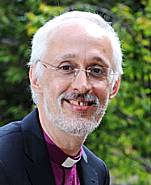
Sermon by Bp. David Walker (visitor) at the North American SOSc retreat, 2014
Nine months ago I was summoned to be interviewed for the post of Bishop of Manchester. It was quite an exercise. First I had to preach for five minutes on the readings of the day. Next I was required to produce a ten minute presentation on a subject chosen by the panel; which happened to be the theology of William Temple and its relevance for Manchester today. Finally, I was submitted to an hour of questions from sixteen people arranged in a large horseshoe. A few days later, by which stage I had been told informally that I was the preferred candidate, I bumped into one of the bishops who had been part of the panel. “You’re different from the rest of us, David” he said. “You really believe in evidence”. It’s possibly one of the nicest things anyone has ever said to me. And I think he did intend it as a compliment.
I also think that it’s a particularly appropriate compliment to pay to the Visitor of this society, because as ordained scientists, the members of SoSc are called to be people who weigh evidence and, along with that evidence and powerfully influenced by it, believe. So let me simply, for all of us here today and especially for those to be admitted to the society, offer some thoughts on what it may mean to be those who “believe in evidence”.
Painting with a full palette
The definition of an expert, as I imagine you are all aware, is that it is somebody who knows almost everything about almost nothing. Specialisation, particularly in science, leads to ever finer divisions into fields that can become so arcane as to be impossible even to state to an outsider. At the turn of the twentieth century, the great David Hilbert listed the top ten unsolved mathematical problems of the day. By and large they were all at least explicable in language an educated non specialist could understand: Fermat’s last theorem and the four colour problem being perhaps the best known. My recollection is that just one remains unsolved. Yet when another nine were added to it to create a top ten for the new millennium, most of them require a considerable amount of prior mathematical specialisation to even begin to understand what the problem means. The days of the generalist scientist, of whom so many were ordained, are long past.
Yet within this ever increasing specialisation are two countervailing forces. Firstly, we can note a dawning awareness that often the solutions to problems couched in the language of one particular field lie at least partially in another area of study entirely. The paradox is that to be fully effective within it, researchers need to engage outside their immediate zone of expertise. Secondly, once we pull back from the frontiers of knowledge and seek to live coherently within the world, we are immediately compelled to construct our attitudes and activities from theory and evidence drawn from many different disciplines.
For you and me there is a very sound reason for applauding this. When we read the gospels we see immediately how, for example, Jesus brings together deep knowledge of the Jewish scriptures, profound observation of nature, acute understanding of human psychology, all in order to address a specific subject. To the people who heard him it would appear to be this ability to synthesise that rooted his teaching in a holistic reality and gave it an authority that contrasted with that of his contemporaries.
The call to us then is to be like the good rabbi of whom Jesus speaks, who can bring out and put together the old and the new. It is to be those who are prepared to paint with the whole available palette of human wisdom. In particular, as a society we have the locus to offer our shared theological training and our very diverse scientific disciplines in order to address the issues of the day. And I do believe this takes us beyond the initial vision of our founders. We are more than a third force in a fruitless culture war between fundamentalist belief and reductionist science. We are a society of those who can individually and corporately make a powerful contribution in the public square. And whilst it is always a little invidious to single any of our members out, for the sake of examples (always important to a scientist) I would draw attention to the writing on environmental issues of David Atkinson, of Lee Rayfield on issues in medical
ethics, and the collection of essays on human sexuality submitted as evidence to the Church of England’s recently published report on the topic. In each case it is the ability to speak from a solid theological and scientific grounding, a belief in the evidence drawn from both, that makes the impact.
The measure of doubt
I was privileged as a young undergraduate to be on friendly terms with a then elderly philosopher, among whose claims to fame was that in his rooms at college a fierce debate had once taken place on the subject of belief and evidence. He described vividly the moment, late in the evening, when Popper refused to accept the existence of the fire poker and Wittgenstein threatened to strike him with it.
I am always amazed at the mental gymnastics employed by some atheist friends in the scientific world who spend their lives not believing they have any free will and yet act constantly as though they did. Those with a sense of humour smile and say they have no choice in the matter. I am equally amazed at those religious fundamentalists for whom it seems to be precisely that their beliefs clash with the entirety of the evidence available and require equally implausible mental gymnastics such as imagining God creating the fossil record to fool us, which attracts them to their faith.
You and I are called to have evidence and to believe. Just as there are different standards of proof for a criminal trial and a civil lawsuit, so we are required to weigh the evidence and determine what an appropriate threshold for belief might be in any particular instance. As in the legal example, an important factor is what the practical consequences of belief or disbelief might be. We need to be far more sure before sentencing someone to years in prison than we need to be before deciding which of two protagonists to believe in a dispute over a commercial contract.
You and I, trained in the scientific method, do not believe lightly. The fact that we believe, and believe enough to base our lives on acting in accordance with our beliefs, stands witness to the plausibility of our faith under challenge. Especially it witnesses to the enduring plausibility of faith under scientific challenge. Faith asserts that we must all live by unproven hypotheses, but hypotheses that remain reasonable in the light of all we know.
Worshiping through the wonderful
For my final point I want to go back to the impact on us of being those who grapple with scientific evidence.
The story is told of two astronomers at a Cambridge college who, every time they felt they were thinking too highly of themselves, would go out into the main court at night, look up at the stars, recite a litany of how small humans are in comparison with the visible universe, and then return duly humbled to their port and Stilton.
Whatever our individual disciplines, whether we study the very large or the very small, the very concrete or the very abstract, we are those who have been privileged to glimpse something more than most people can of the sheer size and complexity of the universe. Like those college dons we are drawn to a profound humility. What then distinguishes us from them though is that as “believers in evidence” we are also drawn into a profound wonder that expresses itself in worship. Like Job, at the end of the book which bears his name, we see the glory of creation, and fall on our knees.
Yet what distinguishes the members of this society even further is that we are also those set apart to be leaders of worship among communities who are not scientifically trained or scientific practitioners. In our society liturgies we express a more profound engagement with the creation than is common in standard church services. That is right and proper. But I hope we can also take something of the spirit of worshipping through the wonderful back into our home churches. I’ve witnessed too many Christian communities for whom worship is about escape from the realities of daily life. For those who experience
daily living as oppressive and rejecting, that is to some extent understandable. But how much better it would be to enable them to worship in a way that by its very connectedness with creation calls up a more profound awareness of a God who is so greater than their oppressors that in his strength they can refuse to accept their oppression. Maybe that is a work for this society, and especially for those being admitted
 Society of Ordained Scientists