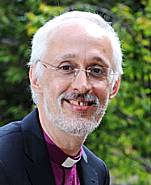
Sermon by the Rt. Rev. Dr. David Walker, Visitor at the Annual Retreat of the Society of Ordained Scientists 1 June 2015, Scargill House
There are probably as many wildly inaccurate myths about scientists as there are about people of religious faith. As priests we are seen as only one step away from those who would walk into a seaside resort and fire bullets at the tourists. As scientists we are only the press of a button from blowing up our planet through a nuclear apocalypse or submerging it beneath a sea of grey goo. All such myths need to have some anchor in a small part of the truth, which is then distorted and expanded so as to assume itself to be the whole of the picture, but most of them are sufficiently laughable as to not impact on the way that we see ourselves. The danger comes when some part of the religious or the scientific community takes on board one of these exaggerations and distortions, and begins to define itself along the lines the myth sets out.
One of those myths is the notion that science must be rooted in scepticism. I was ordained on St Thomas’s day and I rejoice at having that connection with him. But Thomas is not primarily a sceptic, he simply wants the best available evidence, evidence his fellow apostles have already had, before his own eyes. We often forget that the encounter between Jesus and Thomas concludes with the Lord saying, “Blessed are those who have not seen, and yet believe”.
If scientists were sceptics, scientific progress would be much slower than it is. The charism of a scientist is not to be one who doubts and distrusts, we can leave that to the most abstract of philosophers. It is to be a person who spots the recurrent patterns in the natural order, and then studies them. Sometimes that results in finding that a particular pattern has no apparent meaning or no discernible consequences, but it is through the developing and testing of apparent patterns that science, in all its many forms, progresses; because patterns provide predictability.
One of the great marvels of creation is that so much of it is comprehensible, and hence predictable. Why is it that the universe largely obeys some fairly simply written (if sometimes much harder to solve) mathematical equations? How is it that my brain recognises the sounds you are making, and finds enough similarity in the patterns of sound waves others have created to be able to abstract from them a series of words to which common meanings have been assigned? That sometimes we find we are misunderstanding each other because a particular word carries different connotations to us both, or because a concept is not easily translated from one language to another is not. Surprising. What is amazing is how little that happens. The great early twentieth century Christian apologist GK Chesterton marvelled at the fact that when he took his ride on the London Underground, not only did his train always pass through the same stations, but it passed through them each day in exactly the same order. A true sceptic would never dare ride the tube, for fear of arriving in some different and random destination every time.
Jesus again and again invites people to recognise the patterns in things. He reminds his hearers that they are accustomed to looking at the sky and predicting what the weather will be, but are hopeless at recognising the signs of God’s Kingdom coming among them. He describes patterns of human behaviour, such as that a man let off a huge sum of money owed will love the one who has remitted his debts more than one released from a far smaller sum. And he invites people to see humanity as made in God’s pattern, so that his stories tell us not only of how you and I behave but how God himself is too.
When I first moved from being a mathematician to a theologian and priest I was often asked if it wasn’t a very radical change. My early response was to say that I could now count the number of angels balancing on a pinhead from two different theoretical systems. Once I got immersed into public ministry though it was the experience of recognising patterns that stood me in good stead, it proved even more helpful than having learned the Greek alphabet in my previous career.
As a parish priest my work was grounded in the pastoral contacts and engagements I undertook. But meeting with people in their moment of need isn’t the full call of the ordained. I’ve become very fond of a saying coined by Archbishop Desmond Tutu. “When we’ve fished enough bodies out of the water it becomes time to take a trip upstream and see who’s throwing them in.” After a number of pastoral engagements repeated patterns begin to emerge, these can be identified and the pattern itself addressed rather than simply the individual circumstances.
Working repeatedly with young people unable to find accommodation we found that there were particular obstacles to landlords taking them on as tenants. We set up a local ecumenical organisation that was able to provide financial guarantees and tenancy support which made the prospective tea ants much more attractive give. We saved the landlords paying agents’ fee and we ensured the quality of the accommodation was up to standard. We addressed the pattern not just the particularity.
When we’ve heard a selection of stories we can also lay them alongside the narratives in our scriptures and church traditions. In another place we found that the coal mine, for 75 years the main source of employment for young adults, had ceased recruiting. This left many young people effectively rejected by society. We set this alongside the prophesy in Isaiah 65, that in God’s Kingdom people can build for themselves, not just for others. We trained ten young adults in the necessary skills, organisational as well as construction. They formed themselves into a cooperative and built a terrace of houses they could live in.
There’s a method of working here, which I hope any minister would be able to adopt. But for those of us who also have a scientific training, who are trained in this recognition of patterns from a discipline outside of theology, I think there is a particular role we can play in being exemplars of it. For, at the end of the day, to be a good priest and to be a good scientist is to spot the patterns in the world we are engaging with, and to act on them.

 Society of Ordained Scientists