Sermon by The Rev. Dr. Barbara Smith-Moran, SOSc, Annual Retreat, 26 June 2014, Whitby
Almost 100 years ago, Einstein predicted the existence of gravitational waves in his Theory of General Relativity. His equations showed how gravity waves are generated by highly energetic events such as the explosion of supernovae or the collision of neutron stars. Einstein also thought that gravitational waves of cosmic origin would be so weak by the time they reached Earth that they would be undetectable. Now thereʼs a challenge, and from Einstein, no less! But, in 40-odd years of searching, direct observation of gravity waves has proven elusive. But the theory is robust, so physicists persist in the search, the way they do, and keep themselves hopeful with successive generations of ever more sensitive detectors.
Meanwhile, though, a team of astronomers have been searching for indirect observation of cosmic gravitational waves. Theyʼve been looking for the effects of the gravitational waves that accompanied the inflationary period of exponential expansion of the universe in the blink after the Big Bang. And last week, the much-heralded paper was published announcing the discovery of what theyʼve been looking for. The interpretation is controversial and awaits confirmation, as always.
So how did the astronomers do that? Well, they built a special microwave telescope at the South Poleʼs Amundsen-Scott Research Station. They built it there because the very cold air is very dry, minimizing microwave emission from water vapor. That first telescope was called BICEP, an acronym for Background Imaging of Cosmic Extragalactic Polarization. Its detectors were sensitive to the polarization of the Cosmic Microwave Background, which is the 3-degree remnant of the light from the Big Bang.
Quantum theory says that by the time that Big Bangʼs light became observable (after 380,000 yrs), it had been imprinted by the gravitational waves of the faster-than-light cosmic inflation and polarized in a particular way. BICEP was designed specifically to pick up the so-called B-mode polarization, a signature of inflation in the super-early universe (10-32 sec). I canʼt possibly explain what the B-mode is, and I refer you to Garth Barber or Cyril Challice or another physicist.
So BICEP stared into space for 3 winter seasons, beginning in 2006, and it found—well, not much of anything, nothing to make headlines. But the theory is robust—or at least tantalizing—so the physicists persisted in the search, the way they do, keeping themselves hopeful with ever more sensitive detectors.
They built a second generation BICEP. So by 2010, they had BICEP2, a bulked-up version of BICEP1, with a bigger aperture and 10 times the sensors at 150 GHz.
After three seasons of observations, the results from BICEP2 really were something to write home about. The research team, led by Harvardʼs John Kovac, made big headlines last March when they announced their results. Their paper came out last week. The polarization effect is only 1 part in 108, incredibly, incredibly subtle.
I want to know why BICEP1 didnʼt see the signal that BICEP2 saw. The answer is that it did see it, but it just didnʼt recognize it in all the background noise it picked up. BICEP1 needed some “tutelage” from BICEP2 in order to know what it was seeing. The astronomers took the BICEP1 spectral data and mathematically correlated it with the BICEP2 data to produce a third, called the cross-correlation, and there it was—out of the noise jumped something similar to the signal seen by BICEP2. Cross-correlation did the trick. Itʼs a really powerful technique.
…………
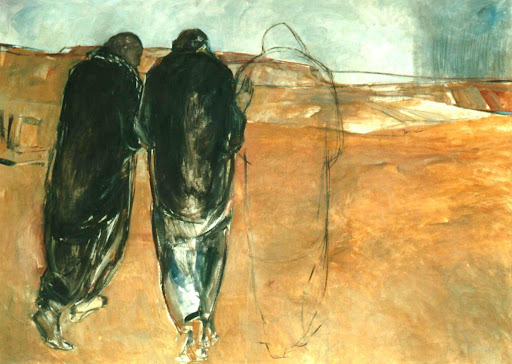
So, that very day two of them were going to a village named Emmaus, about seven miles from Jerusalem. We know that our Gospels contain two kinds of parables: parables told by Jesus, and parables told about Jesus. Todayʼs story of the Road to Emmaus is one of the latter; itʼs a parable about Jesus. It works on two levels, as parables do. And to press cross- correlation into service as a scientific metaphor, let me retell the Road to Emmaus story this way.
Cleopas and his friend were walking together, traveling away from Jerusalem on the Sunday after the Passover. Both of them had been in the company of other Jewish followers of Rabbi Jesus of Nazareth. They had heard and seen something of the things that were being reported about Jesus: especially that he was dead on Friday and alive again on Sunday. Both of them had experienced something of the energy that began to polarize the Jews into resurrection believers and resurrection deniers, into Jesus-is-Lord believers and Jesus-is-Lord deniers.
So on their way out of the center of Passover activity, on their way home, perhaps, to Emmaus, these two are talking. Letʼs suppose that Cleopas was rather animated. Perhaps he had been calling himself a disciple of Jesus ever since he had heard him preaching his own compassionate take on the Law and the Prophets. Cleopas heard Jesusʼs words as a refreshing rain, and he yearned to hear more. But then those insistent kill-joys, the Roman authorities, had killed Jesus right at holiday time. That was only last Friday; and today, Sunday, the most incredible news had been spreading through Jerusalem: the news that many had seen Jesus alive again, and walking among them, talking and eating with them. Cleopas is confident that the reports are true. He understands the excitement of many of the disciples, and he thinks, cautiously and privately, that he may have seen his own evidence of the Risen Jesus. He felt uncomfortable in the company of those others who had thrown caution to the winds, so he and his friend leave the excitement and confusion of Jerusalem behind and head out.
Walking toward Emmaus now, Cleopas, the more extroverted, does most of the talking. Both of them have been through the same Jerusalem Passover and post-Passover experiences. His friend—letʼs call her BICEP—isnʼt so sure. BICEP is skeptical about the eye-witness reports she heard. She is not easily carried away. She maintains that God has never answered any of her prayers, though she keeps praying. Influenced by Cleopas, BICEP wants to believe, she wants and needs Jesus to be Lord, but she doesnʼt see it, not yet.
As they go over and over their shared Jerusalem experience, Cleopas interprets it in such a way that he, at least, is convinced he can see the hand of God at work. Reviewing the words of the prophets about the coming Messiah, it dawns on both of them, as never before, the relevance of these words to Jesus. The signal just pops out of the noise—and there is
Jesus himself, walking beside them. Both of them see him, walking and talking with them.
BICEP is positively aghast at what she now sees in front of her eyes. How did she miss that before? Apparently, it was there all along, but she couldnʼt see it on her own. It was buried in the noise of coincidence. She needed to be tutored in order to see it. She needed the fellowship of Cleopas. She needed that cross-correlation so the Risen-Lord truth could pop out of the noise of random circumstance in her life. I believe thatʼs how the Counselor, the Holy Spirit often works to guide us into all truth, and tutor us all things, as Jesus says in Johnʼs Gospel, and remind us of all that Jesus has taught us.
When they get to Emmaus, they invite Jesus in and break bread with him to celebrate their experience of his living presence. Then, exhilarated by their discovery, Cleopas and BICEP have no choice, no choice at all, but to turn around and head right back to Jerusalem to hold their own press conference about their experience of the Risen Lord. As the Epistle lesson says, “That which we have seen and heard we proclaim also to you, so that you may have fellowship with us, . . . with the Father and with his
Son Jesus Christ.”
In the name of God, Creator, Redeemer, and Cross-correlator. Amen.
 Society of Ordained Scientists